
You probably don’t think of getting out of a chair as exercise.
Or carrying groceries from your car.
Or stepping onto a curb while walking through downtown Stamford.
But your body doesn’t care what you call these things.
It still has to produce enough strength to stand. Control your body as you step down. Keep you steady while you reach overhead. Carry a bag from one place to another.
These ordinary moments are one of the biggest reasons strength training matters after 50.
You aren’t building strength just to become better at exercises.
You’re building strength for everything you do when you’re not exercising.
1. Every Time You Get Out of a Chair, You’re Practicing a Strength Movement
Think about how many times you stand up during an ordinary day.
You get out of bed. Stand from the breakfast table. Get up from your desk. Rise from the couch. Get out of a restaurant booth.
Each time, your legs and hips help move your body from a lower position to a higher one.
In strength training, we practice a very similar pattern with movements such as a sit-to-stand or squat.
For a beginner, that might literally mean sitting on a bench and standing back up.
As someone becomes stronger, the bench might become lower. They might hold a weight. Or the movement might change in another small way.
The gym exercise isn’t random.
It’s practice for a movement your body already needs.
2. Stairs Are Basically Repeated Step-Ups
Here’s another exercise hiding in plain sight.
Put one foot on a stair.
Push through that leg.
Bring your body upward.
Repeat.
That’s remarkably similar to a step-up you might practice during a strength session.
And there’s a reason coaches care about strengthening this pattern.
Maybe it’s the stairs at home. The steps at the Stamford train station. A high curb. Stadium seating. Or the staircase at a friend’s house.
You don’t necessarily need to become someone who can do dozens of step-ups.
You want enough strength that the steps outside the gym require less of your total capacity.
That’s a much more useful way to think about getting stronger.
3. Carrying Groceries Is Strength Training in Disguise
You leave the grocery store with a bag in each hand.
Now your body has several jobs.
Your hands have to hold the bags. Your arms and shoulders support them. Your midsection helps keep you steady. Your legs move you toward the car.
In the gym, we call a similar exercise a loaded carry.
You hold a weight and walk.
It may not look particularly impressive—and that’s exactly the point.
The CDC includes carrying groceries among the many everyday activities that count toward being physically active and recommends muscle-strengthening activity as part of an active lifestyle for older adults.
Sometimes useful strength training looks surprisingly ordinary.
4. Reaching, Bending and Getting Down Are Movements, Too
Dropped something on the floor?
Reaching into a low cabinet?
Picking up a laundry basket?
Getting down to play with a grandchild?
Again, your body has to solve a movement problem.
You need to bend, reach, control your position and then come back up.
Strength training gives you opportunities to practice pieces of those movements in a controlled environment.
The goal isn’t to perfectly copy every activity you’ll encounter in life.
It’s to build a stronger toolbox.
Then, when everyday life asks you to bend, reach, carry, push, pull or stand, your body has more capacity available.
5. Balance Shows Up When You Least Notice It
Balance isn’t only standing on one leg with your eyes closed.
You use it constantly.
Step over a puddle and you’re briefly on one foot.
Put on a pair of pants while standing and you’re balancing.
Walk across uneven grass at a Stamford park and your body is making small adjustments with every step.
That’s why balance can also be incorporated into training.
The CDC recommends that adults 65+ include activities that improve balance alongside aerobic and muscle-strengthening activity.
That doesn’t mean every exercise needs to become a balancing trick.
Sometimes it’s simply practicing stepping, controlling your position, or becoming more comfortable when your weight shifts from one leg to another.
“I Didn’t Even Realize I’d Lost It.”
One of our members, Gloria, shared an observation that captures this idea beautifully:
“I had lost the ability to jump and skip without even realizing it—and now I’ve rebuilt that strength and confidence.”
That’s what makes everyday strength interesting.
Sometimes you don’t notice a movement becoming harder because the change happens gradually.
You simply adapt.
You use the railing more. Avoid getting on the floor. Take two trips with the groceries instead of one.
Then, as you get stronger, you may notice the opposite happening.
Something that used to require thought suddenly…doesn’t.
What This Means for You
Strength training after 50 doesn’t have to be about becoming a “gym person.”
Think of it as preparation.
You practice sitting and standing so your legs are prepared when a chair is lower than expected.
You practice carrying so your body is prepared for groceries and luggage.
You practice stepping so stairs and curbs don’t demand as much from you.
You practice reaching, pushing, pulling and balancing because everyday life is full of all of them.
And you don’t need to be able to do every version on day one.
At Core Principles, our adults 50+ begin with two one-on-one Foundation Sessions before joining our small groups of up to six. Exercises can be modified around knees, hips, backs, confidence levels and individual starting points.
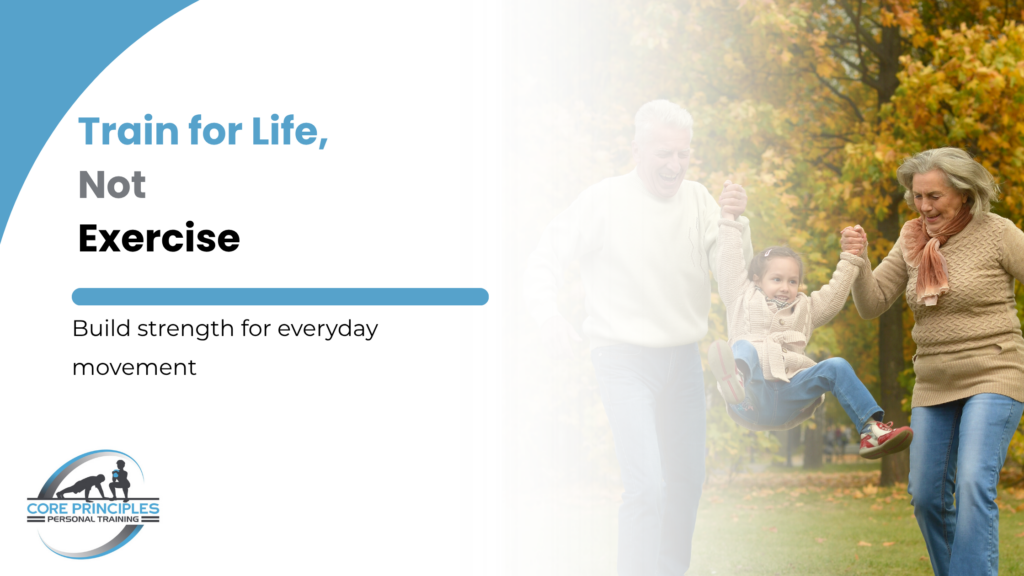
The purpose isn’t to train for the gym.
The purpose is to train for your life.
Pay Attention to What You Want to Keep Doing
After 12 years of helping adults 50+ in Stamford, we’ve learned that people’s goals often sound much simpler than they expect.
“I want stairs to feel easier.”
“I want to keep traveling.”
“I want to get off the floor.”
“I want to carry my own things.”
Those aren’t small goals.
They’re everyday life.
If you’re over 50 in Stamford and want to learn how strength training could support the things you want to keep doing, reach out to Core Principles and talk with us.
You don’t need a goal that sounds impressive.
Start with the life you want to keep living—and build strength for that.