
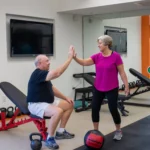

Imagine two people standing next to each other in a gym.
They’re both doing a leg exercise. One uses a weight. The other holds onto a support and doesn’t go as low.
Who’s doing it correctly?
Potentially, both of them.
Personalized strength training isn’t about inventing completely different workouts for every person. Often, it’s about knowing which “dial” to turn so an exercise fits the individual.
Here are six of those dials.
1. Range: How Far Do You Move?
Imagine you’re practicing a squat.
One person can comfortably sit toward a low bench. Another feels much better using a higher surface.
The goal doesn’t have to change just because the range does.
Reducing the range can give someone an appropriate starting point. As strength, comfort and control improve, the coach can reassess.
This is particularly useful for people who arrive concerned about their knees, hips or backs.
2. Support: How Much Help Do You Need?
Support can completely change an exercise.
Picture practicing a step-up. One person steps onto a platform without holding anything. Another keeps a hand on a stable support.
That hand doesn’t make the exercise “less legitimate.”
It may allow that person to concentrate on pushing through the leg, controlling the movement and gradually building confidence.
The goal isn’t to remove support as quickly as possible. It’s to use the amount that’s appropriate today.
3. Load: How Much Resistance Do You Use?
The heaviest weight isn’t automatically the best weight.
Perhaps you carry a 10-pound dumbbell while someone beside you carries 20. Your coach is looking at how you respond.
Can you maintain control? Does your technique change? How challenging were the final repetitions?
The CDC recommends muscle-strengthening activity at least twice a week for adults 65+, while also emphasizing that physical activity should suit an individual’s abilities. See the CDC’s recommendations for older adults.
The useful weight is the one that creates an appropriate challenge for you.
4. Position: Can We Change the Setup?
Sometimes the easiest way to make an exercise work better isn’t changing the weight at all.
It’s changing your position.
A movement might be performed standing, seated, using a bench or from another setup entirely.
Think about someone who has difficulty getting comfortably onto the floor. There is little value in making the floor itself the barrier to participating. A coach can choose a position that allows the person to work toward the intended goal without turning the setup into the hardest part.
5. Pace: How Quickly Should You Move?
Slower isn’t always easier.
Try standing up from a chair quickly. Now try taking three controlled seconds to lower yourself back down.
Very different experience.
Changing speed can increase challenge without immediately adding weight. At other times, a coach may give you more time between repetitions or exercises.
Good training doesn’t need to feel rushed to be productive.
6. Exercise Choice: What If This Version Simply Isn’t for You?
Sometimes the best modification is choosing something else.
Avram describes this well. Despite a history that includes back, knee and shoulder surgeries, he found that his exercises could be tailored to his needs:
“Moreover, if something else causes an issue, they modify the exercise. I was pleasantly surprised.”
He also points out something important: the work can still be difficult.
Personalized does not mean easy.
It means finding a productive way to challenge someone rather than forcing everyone through the same movement.
What This Means for You
When you see someone performing a different version of your exercise, don’t assume they’re ahead of you or behind you.
You may simply have different settings on those six dials.
At Core Principles, our groups have a maximum of six people because coaches need to be able to observe what’s happening. Adults 50+ aren’t handed an identical routine and left to figure it out.
Over time, those dials can change, too.
A little less support. A slightly larger range. A heavier weight. A new version.
That’s progression.
After 12 years of working with adults 50+ in Stamford and now opening in Norwalk, we’ve learned that personalization isn’t an extra feature added when something goes wrong.
It’s part of the training itself.
If you’ve been putting off strength training because you’re worried that standard exercises won’t work for your knees, hips, back or current ability, that doesn’t necessarily mean you can’t train. It may mean you need a different version and a coach who knows how to find it.
In the Norwalk area? Our new Core Principles location just opened. Visit the Founding Members page for details about the 28-Day Kickstart and the latest opening updates:
https://coreprinciplesnorwalk.totaltransformationtoday.com/founding-members
You don’t need to fit yourself into a workout. The workout should be coached to fit you.