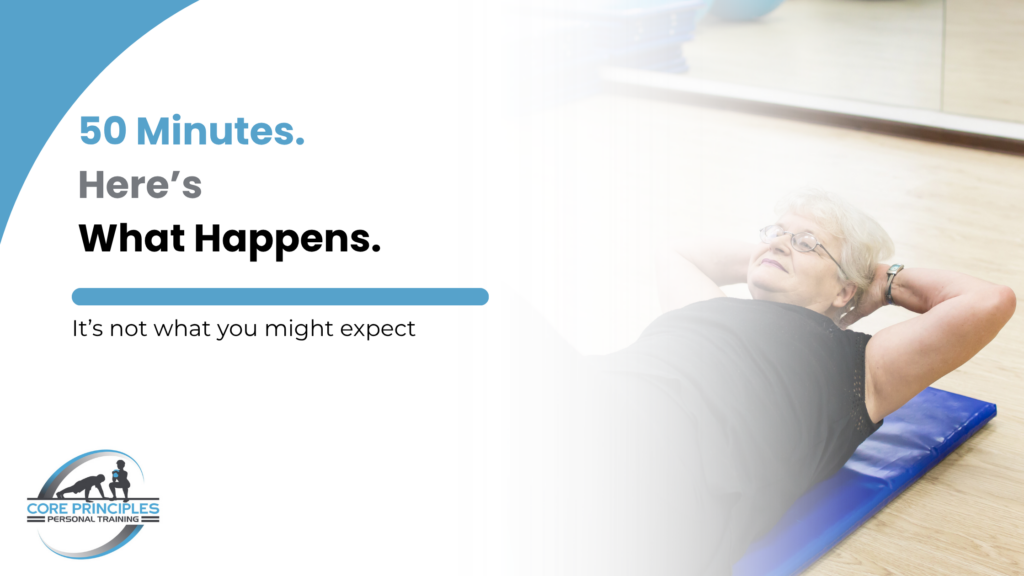
If you haven’t exercised in years, 50 minutes can sound like a long time.
You might picture 50 minutes of nonstop exercise, trying to keep up with everyone around you, or wondering how you’ll know what to do next.
But a well-coached strength training session after 50 doesn’t work that way.
At Core Principles in Stamford, a 50-minute session has a rhythm. There are moments to warm up, learn, work, rest, ask questions, adjust exercises, and catch your breath. And because our small groups have a maximum of six people, the goal isn’t for everyone to move at the same pace.
Here’s what those 50 minutes can actually look like.
Minutes 1–10: How Does the Session Begin?
The first few minutes aren’t about seeing how hard you can work.
They’re about getting ready.
You might walk in and chat with your coach for a moment. Maybe you mention that you spent the weekend working in the yard and your back feels a little stiff. Maybe your knee feels different today. Or maybe you feel great and you’re ready to go.
Those little conversations matter because your coach can use that information when guiding your session.
Then you’ll begin moving.
The first exercises are usually simple movements designed to prepare your body for what’s ahead. Rather than thinking of this part as something to “get through,” think of it as the transition between whatever you were doing before you arrived and the strength work you’re about to do.
For someone who is nervous about starting, those first few minutes also provide something important: time to settle in.
Minutes 10–25: What Does the Actual Strength Training Look Like?
This is where you’ll begin working through the exercises planned for you.
And if you look around the room, you’ll probably notice something interesting.
Everyone isn’t necessarily doing the same thing.
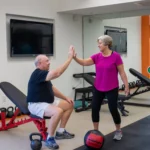
One person might be doing a sit-to-stand from a bench while someone else is holding a weight as they squat. One member may be using a different range of motion because of their knees. Someone else may be ready for a heavier weight because they’ve practiced that movement for months.
Your coach moves around the room, checking technique, answering questions, adjusting exercises, and helping each person find the appropriate challenge.
That’s one of the biggest differences between coached small-group strength training and the big “class” many people imagine.
You aren’t trying to keep up.
You’re following your plan.
Minutes 25–40: What Happens When Something Feels Too Hard—or Too Easy?
This part of the session is where coaching becomes especially important.
Suppose you’re doing an exercise and something doesn’t feel quite right in your knee.
You don’t have to push through it just because it’s written on the plan.
Your coach might change your foot position, shorten the movement, change the exercise, or find another way to train the same general movement comfortably.
The opposite can happen, too.
Maybe something that used to require a lot of concentration suddenly looks easy.
That’s useful information.
Your coach might increase the weight slightly, give you a different version, or simply make a note that you’re ready to progress soon.
Progress isn’t about making every exercise harder every time you walk through the door. It’s about applying the right amount of challenge at the right time.
The U.S. Physical Activity Guidelines recommend muscle-strengthening activity for older adults and emphasize that people who aren’t currently able to meet the full recommendations should begin with what they can do and gradually build from there.
That’s an important principle at any age: you don’t need to prove you’re fit enough to begin. You build capacity by beginning.
Minutes 40–50: How Does the Session End?
By the final few minutes, you’ve accomplished quite a bit.
You’ve practiced several movements. You’ve challenged your muscles. Your coach has seen how your body responded that day.
And then you’re done.
There’s no requirement that you crawl out the door exhausted for the workout to “count.”
In fact, one of the beliefs we often help people change is the idea that a successful workout has to leave you completely wiped out.
For adults over 50, the bigger goal is consistency.
You want to be able to train today, go about your normal life tomorrow, and come back again.
Maybe you’re heading to the grocery store on High Ridge Road afterward. Maybe you’re meeting someone downtown. Maybe you’re picking up your grandchildren.
Strength training should support that life—not take you out of it.
What If 50 Minutes Still Sounds Intimidating?
That’s completely normal, especially if your last experience with exercise was years ago.
You aren’t expected to walk into Core Principles knowing the exercises, understanding the equipment, or knowing how much weight you should use.
That’s why new members don’t simply get dropped into a group on day one.
We begin with two one-on-one Foundation Sessions. Those sessions give you time to learn basic movements, ask questions, talk about limitations involving your knees, hips, or back, and become familiar with how everything works before joining the small-group environment.
Over 12 years of working with adults 50+ in Stamford, we’ve seen how much easier starting can feel when someone knows exactly what to expect.
One member described the experience simply:
“Each workout can be adjusted to my limitations. The trainers are always right there to help and are extremely knowledgeable and supportive.” — Sharon
That support doesn’t disappear once you learn the basics. It’s part of the session.
What This Means for You
A 50-minute strength session isn’t 50 minutes of proving what your body can do.
It’s 50 minutes of practicing what you want your body to keep doing.
Standing up. Carrying things. Stepping confidently. Reaching. Pushing. Pulling. Maintaining balance.
Federal physical activity guidance supports strength and balance work as important parts of staying active as we get older. The goal isn’t to suddenly become an “exercise person.” It’s to give your body regular opportunities to maintain and build the abilities everyday life asks of it.
You Don’t Have to Be Ready for Everything. Just Ready to Start.
If you’ve been wondering what strength training after 50 would actually feel like, sometimes the uncertainty is harder than the workout itself.
Once you know there’s a plan, a coach, modifications when you need them, and no expectation to keep up with anyone else, the experience can look very different from the gym environment you may have pictured.
If you’re in Stamford and you’re curious about getting stronger but aren’t sure where to begin, reach out to Core Principles.
Ask us questions. Tell us what’s making you hesitate. Come learn how the process works.
You don’t have to decide that you’re ready for every workout ahead.
You only have to decide whether you’re ready to find out what your first one could look like.