


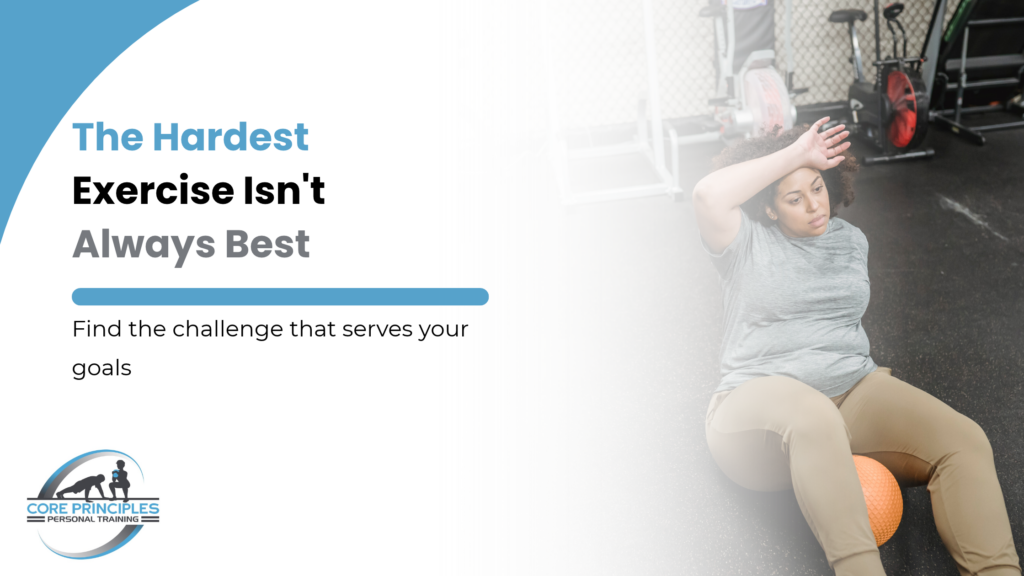
The best exercise isn’t always the one that looks hardest. It’s the one that challenges you in a useful way.
“If your coach gives you a different version of an exercise, does that mean you’re not strong enough to do the real thing?”
It’s easy to think that way, especially when someone beside you is lifting a heavier weight or moving through a bigger range.
But here’s something worth considering: a harder-looking exercise isn’t always a better exercise for you.
For adults over 50, understanding exercise modifications for strength training can change how you think about progress, effort, and what effective training actually looks like.
Why Do We Associate Modifications With Weakness?
Many of us grew up believing that harder automatically means better.
More weight. More repetitions. A deeper squat. A more complicated movement.
So when a coach suggests using a chair for support or changing your position, it can feel like you’re taking a step backward.
But exercise isn’t a competition to see who can perform the most impressive-looking movement.
Imagine trying to strengthen your legs while struggling to maintain your balance.
You might spend so much attention trying not to wobble that you can’t comfortably focus on the movement itself.
Adding support doesn’t necessarily remove the challenge from your legs.
It may allow you to train them more effectively.
That’s the difference between making an exercise look harder and making it useful.
What’s the Difference Between Easier and More Appropriate?
An exercise modification changes how a movement is performed.
Sometimes that means reducing difficulty.
Other times, it means removing an unnecessary obstacle so the intended muscles can work more effectively.
For example, if someone can comfortably perform a movement with good control, consistently reducing the resistance may eventually limit their progress.
But if someone struggles with balance during a standing exercise, adding support may allow them to use an appropriate resistance while maintaining better control.
The goal isn’t to make every workout comfortable or effortless.
It’s to find a level of challenge that matches the person’s abilities and training goals.
The National Institute on Aging’s exercise guidance emphasizes choosing appropriate activities and building gradually.
That principle applies whether you’re completely new to exercise or have been training for years.
How Can a Small Change Make an Exercise More Effective?
Consider three common strength exercises.
- Squat: Adding Support to Improve Control
Someone performing an unsupported squat may struggle to maintain balance.
Using a stable chair or support can allow them to focus on controlled leg movement rather than worrying about losing their footing.
The exercise may still feel challenging.
- Row: Changing Position to Focus on Pulling
A standing row requires someone to maintain their body position while pulling resistance.
For certain individuals, a supported row may help them focus more effectively on the muscles involved in pulling.
Changing the position doesn’t automatically make the exercise less valuable.
- Step-Up: Choosing a Useful Height
A higher step isn’t always better.
If someone struggles to control the movement, a lower step may allow more consistent practice.
As strength and control improve, the height may be adjusted when appropriate.
These examples aren’t prescriptions for specific injuries. They show how changing an exercise can improve its suitability.
How Does a Coach Know Whether You’re Working Hard Enough?
A good coach doesn’t judge an exercise only by how much weight you’re lifting.
They pay attention to how you’re performing it.
Are you moving with control? Can you maintain an appropriate position? Do the final repetitions feel challenging? Are you able to work through a comfortable range?
They also listen when something doesn’t feel right.
An exercise can be demanding without being painful.
At Core Principles Personal Training, coaches work with adults 50+ in groups of no more than six, allowing individual adjustments within a supportive setting.
Member Nanette described how coaches correct positioning, listen to questions and concerns, and guide members toward increasing weights at their own pace.
Her experience illustrates how adjustments and progress can work together.
A modification isn’t necessarily a permanent limitation.
It may be a useful step toward a different challenge—or it may remain the best variation for someone’s goals.
What Does This Mean for Your Progress?
Imagine you’ve been using a supported squat for several weeks.
As your control improves, your coach might reduce the amount of support, change the movement range, or introduce resistance.
But there’s no requirement that everyone progress on the same schedule.
And sometimes keeping an exercise unchanged is the right decision because it continues to provide a useful challenge.
What this means for you: The value of an exercise isn’t determined by how impressive it looks. It’s determined by whether it helps you work toward your goals with an appropriate level of effort.
Smarter Training Isn’t About Taking Shortcuts
Whether you want to feel stronger carrying groceries through Stamford, enjoy weekend walks, or remain active as you age, your training should serve those goals.
For 12 years, Core Principles has helped Stamford adults 50+ approach strength training with individualized coaching and realistic progression.
You don’t have to perform the same exercise as the person beside you to make meaningful progress.
You need a challenge that makes sense for you.
Want to learn how personalized strength training works?
Stamford: Reply START to learn about our 14-Day “New to Strength Training” Trial.
Norwalk: Visit our Founding Members page for information about the 28-Day Forever Strong Kickstart and opening updates.
Contact Core Principles Personal Training to ask how our coaches choose exercises, make adjustments, and help members progress.