
“Eight…nine…ten!”
If that’s your picture of personal training, it raises a fair question:
Why do I need someone to count repetitions for me?
You don’t.
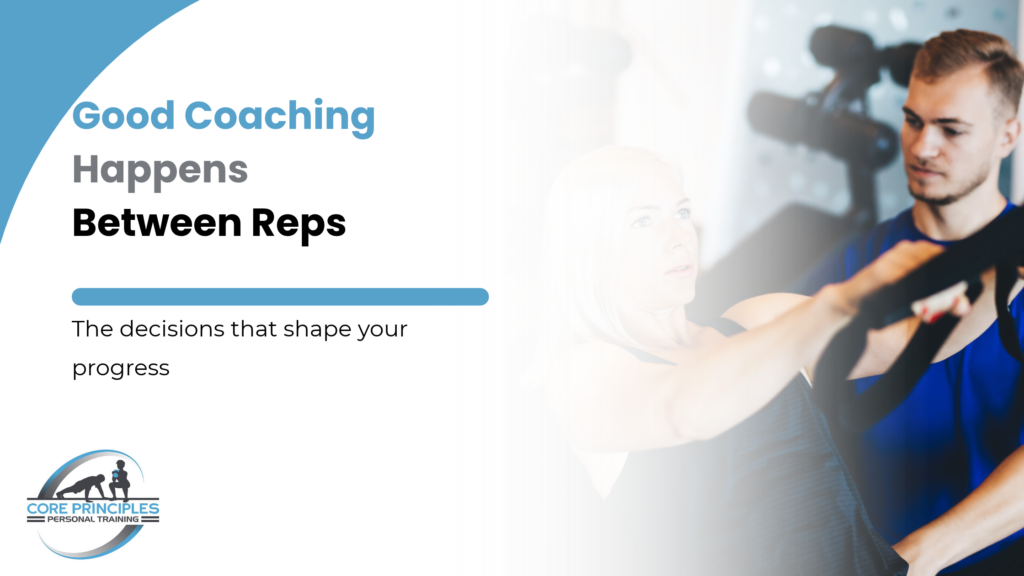
The valuable part of coaching happens around those repetitions: deciding what you should do, watching what actually happens, making small adjustments and remembering that information the next time you walk through the door.
To make that concrete, let’s follow one simple exercise from beginning to end: standing up from a bench while holding a weight.
Step 1: Why Did the Coach Choose This Exercise?
Before the first repetition, a decision has already been made.
The coach has considered what you’re working toward, what you’ve done previously and which version makes sense today.
Standing from a bench may help develop strength for something you do constantly outside the gym: getting out of a dining chair, standing from the couch or rising from a bench at Cove Island Park.
But your version might not look like someone else’s.
The bench height, weight and movement range can all be changed.
That’s the first part of coaching: choosing intentionally rather than randomly.
Step 2: What Is the Coach Watching?
You begin your first few repetitions.
Now your coach watches.
Are you controlling the movement? Does one part look unusually difficult? Does the weight appear appropriate? Are you moving differently than you did last week?
This is why good coaching isn’t simply standing beside someone and cheering.
Joan, a Core Principles member, puts it simply:
“Core trainers are astute at tailoring my exercises to my abilities and restrictions. The time passes and the progress comes with my effort and their expertise.”
That combination matters.
Your effort is essential. Coaching helps direct that effort.
Step 3: Why Do Coaches Give Small Cues?
Maybe the coach says:
“Slow that part down.”
Or:
“Try pushing through your feet.”
Then you repeat the movement.
A cue isn’t supposed to turn the exercise into a complicated anatomy lesson. Often, a few simple words can help you understand what to do differently.
And if the cue doesn’t help?
A good coach tries another explanation.
The objective isn’t for you to learn the coach’s language. It’s for the coach to find language that makes sense to you.
Step 4: Why Do They Keep Asking, “How Did That Feel?”
Observation tells a coach a lot, but it doesn’t tell them everything.
That’s why you’ll often hear questions such as:
“How did that feel?”
“Where did you feel it?”
“Was that too easy, too hard or about right?”
Your answer is information.
If something feels uncomfortable, the coach can investigate and change the setup. If the exercise feels solid and appropriately challenging, that information matters too.
The National Institute on Aging recommends gradually increasing activity and starting with an intensity appropriate for your current fitness level. It also specifically notes that working individually or in a small group with a personal trainer can provide personalized guidance. Read the NIA’s tips for getting and staying active as you age.
Step 5: What Happens After the Exercise Is Finished?
This is the part you may never notice.
The coach remembers or records what happened.
Perhaps 10 pounds was a good challenge. Maybe the higher bench worked better. Perhaps your control has improved enough that next time you could try something slightly different.
Training becomes more useful when each session provides information for the next.
That is how progression can happen without turning every workout into a test.
What This Means for You
You don’t need a coach because you’re incapable of exercising alone.
Coaching provides another set of experienced eyes.
Your job is to show up, put in effort and communicate.
Your coach’s job is to make decisions: choose, explain, observe, adjust, ask, record and decide what comes next.
That’s also why Core Principles keeps coached groups to a maximum of six adults. Coaches need the opportunity to actually coach, rather than simply demonstrate an exercise at the front of a crowded room.
For beginners, the process starts even smaller with two 1:1 foundation sessions.
After 12 years of working specifically with adults 50+ in Stamford and now on Norwalk, we’ve seen how much confidence can come from understanding that you aren’t expected to figure everything out yourself.
And that may be the biggest difference between having access to exercise equipment and having coaching.
The equipment gives you something to use. Coaching helps determine what to do with it.
Core Principles is coming your way. Visit our Founding Members page to learn about the 28-Day Kickstart, what to expect from the new location, and opening updates:
https://coreprinciplesnorwalk.totaltransformationtoday.com/founding-members
Sometimes the most important first step is simply finding a place where you don’t have to figure everything out by yourself.