
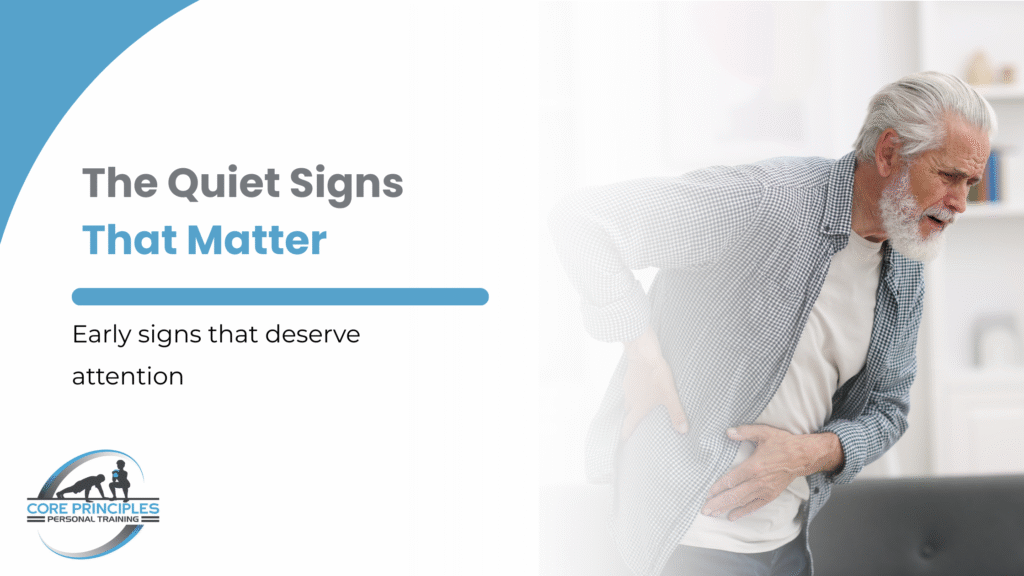
Have you noticed yourself being a little more careful lately?
Maybe you hold the railing when you use the stairs.
You watch the sidewalk more closely on uneven ground.
You brace yourself for a moment before standing up from a chair.
For many adults in their 50s, 60s, and beyond, these changes feel small—but noticeable.
Most people shrug them off and think, “This is just aging.”
Sometimes, though, these moments aren’t about age.
They’re about your body quietly asking for more support.
Why These Small Signals Matter After 50
Bone density loss doesn’t arrive with a warning light.
There’s usually no pain. No dramatic event. No obvious “something is wrong” moment.
According to the National Osteoporosis Foundation, many people don’t realize their bones are weakening until after a fall or fracture. That’s why awareness—not worry—is the most important first step.
Noticing changes early gives you options.
Waiting until something forces the issue takes those options away.
Common Early Signs People Often Ignore
Feeling less steady than you used to
Feeling unsteady doesn’t automatically mean bone loss—but it can signal changes in strength, balance, and the systems that support your skeleton.
Balance issues often show up before bone problems become serious.
Avoiding things you once did without thinking
You might catch yourself:
- Letting someone else carry the heavier bag
- Choosing the elevator instead of the stairs
- Shortening walks or skipping uneven paths
This isn’t laziness. It’s your body protecting itself.
The problem is that less movement over time actually accelerates bone loss.
Minor bumps feel more concerning
Being more aware of falls or slips is common after 50. That awareness is smart—but it’s also a sign that strengthening your support system matters more now than it did before.
What About Posture or Height Changes?
Subtle posture changes—or feeling like you’ve “shrunk” a bit—can also be associated with bone changes over time.
Research cited by the National Institutes of Health suggests these changes can be related to spinal strength and bone health.
This doesn’t mean panic.
It means prevention becomes more valuable.
The Part Most People Get Wrong
When people notice these signs, they often think they need to:
- Push harder
- Try intense workouts
- Or do something dramatic
That usually backfires.
Here’s the belief shift that matters:
Bone health doesn’t improve through fear or force.
It improves through consistent, appropriate movement.
The Centers for Disease Control and Prevention consistently shows that even modest increases in activity—when done safely—can improve bone strength and balance outcomes in older adults.
What actually helps:
- Strength training for hips and legs
- Balance-focused exercises
- Regular weight-bearing movement like walking
None of this needs to feel scary.
It should feel controlled, repeatable, and confidence-building.
Awareness Is Not a Diagnosis
Noticing these signs does not mean something is wrong with you.
It means you’re paying attention.
And paying attention early is what allows you to act calmly, safely, and effectively—before life starts feeling smaller.
Turning Awareness Into Confidence
Bone health isn’t about waiting for a problem to appear.
It’s about building support before you need it.
If you live in Stamford and want guidance on how to strengthen safely—without guessing, rushing, or risking injury—Core Principles Personal Training exists for exactly this reason.
With a clear plan and the right support, uncertainty turns into confidence.
And confidence changes how you move through your life.
If this resonated, the next step doesn’t have to be big.
Sometimes it’s just a conversation—and seeing what’s possible when you’re supported the right way.