
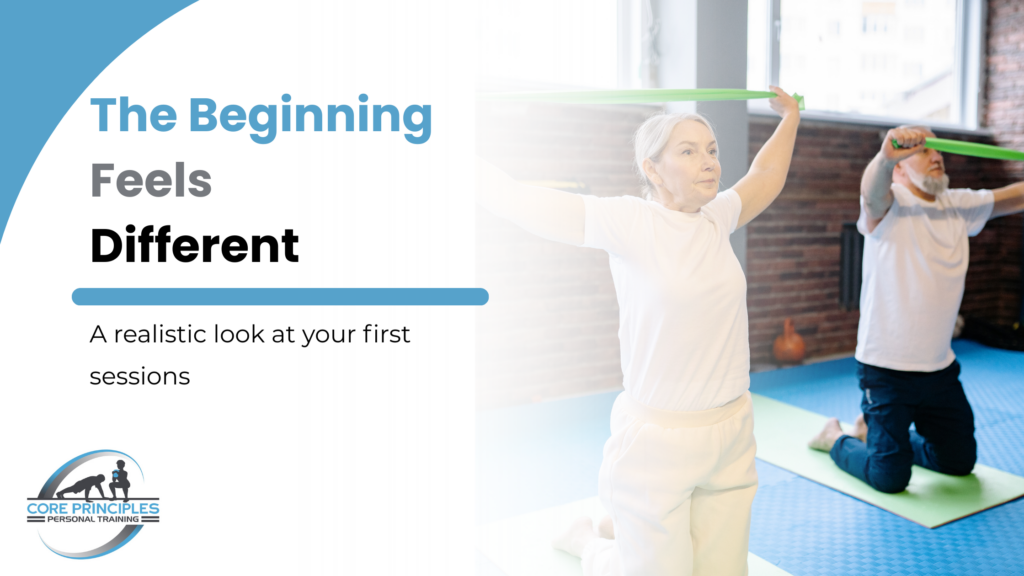
You sign up.
Then almost immediately, the questions begin:
How sore will I be?
Will I feel stronger right away?
What if I can’t keep up?
For many adults over 50 in Stamford, the hesitation isn’t about motivation — it’s about uncertainty. When you don’t know what to expect, it’s easy to assume the worst.
And that matters.
Because the first two weeks of strength training after 50 aren’t about dramatic transformation. They’re about orientation. They’re about teaching your body — and your brain — that movement is safe, manageable, and repeatable.
When you understand what’s normal during this early phase, fear turns into clarity. And clarity builds confidence.
Week 1: Orientation, Not Intensity
The first week is not about testing limits. It’s about learning the language of your body again.
Expect:
- Slower, more controlled movements
- Lighter resistance than you anticipated
- More coaching and conversation than exhaustion
- Mild soreness 24–48 hours later
Many people are surprised that sessions feel calmer than they imagined.
Your nervous system is gathering information:
Is this safe? Is this predictable? Can I trust this?
That’s why good programs focus on repetition and consistency early on. According to the National Institute on Aging, gradual progression is key for older adults beginning strength training.
You’re not trying to prove anything in week one.
You’re establishing a baseline.
What You Might Feel Physically
Here’s what’s realistic:
✔ Slight stiffness getting out of bed
✔ Muscles feeling “used” in a new way
✔ Improved awareness of posture
✔ Better sleep some nights
What you likely won’t feel yet:
✖ Dramatic strength gains
✖ Immediate physical transformation
✖ Complete elimination of aches
The first week is about adaptation, not performance.
Think of it like taking a new route through downtown Stamford. The first drive feels unfamiliar. By the third time, you stop thinking about every turn.
Your body works the same way.
Week 2: Familiarity Begins to Replace Intimidation
By week two, something subtle shifts.
Movements feel less foreign.
You hesitate less before each exercise.
You recover faster between sessions.
You may notice:
- Stairs feel slightly easier
- Getting up from chairs feels smoother
- Balance feels steadier
- Less mental resistance before workouts
Not drama.
But noticeable.
This is when most people realize:
“I can do this.”
The CDC emphasizes that consistency — not intensity — drives improvement for adults over 50.
Two weeks doesn’t change your body overnight.
It changes your relationship with movement.
What Doesn’t Happen (And Why That’s Good)
It’s important to gently shift a common belief:
Progress does not require exhaustion.
If you leave every session depleted, something is off.
In the first two weeks, you should leave thinking:
“I feel worked… but capable.”
Not:
“I hope I recover from that.”
After 50, progress is built on repeatability.
Movements that feel safe today and safe tomorrow are what build long-term strength.
You are not chasing intensity.
You are building trust.
Reassurance: If You Feel Unsure, You’re Right on Track
Nearly every adult starting strength training after 50 shares some version of:
“I just don’t want to make things worse.”
That caution is responsible — not limiting.
Your brain is simply adjusting to something new.
By the end of the second week, most people aren’t fearless. They’re informed.
They understand:
- What soreness feels like
- What normal effort feels like
- What their starting point actually is
And once that uncertainty fades, consistency becomes much easier.
A Realistic Mindset for the First 14 Days
Instead of asking:
“Am I stronger yet?”
Try asking:
“Do I feel more familiar with these movements?”
Instead of:
“Is this hard enough?”
Try:
“Can I repeat this safely next week?”
Those small mental shifts change everything.
Because the first two weeks are not about transformation.
They are about establishing momentum.
The First Two Weeks Build the Foundation
If you’re considering starting strength training after 50, know this:
The first two weeks are quieter than you think.
They’re not dramatic.
They’re not extreme.
They’re foundational.
And foundation is what allows you to keep walking comfortably along the waterfront, carry what you need without hesitation, and stay strong and independent in everyday Stamford life.
If you’d like to better understand what your first two weeks could look like, we’re happy to answer your questions.
Feel free to contact us for more information — sometimes clarity is the most powerful first step.