


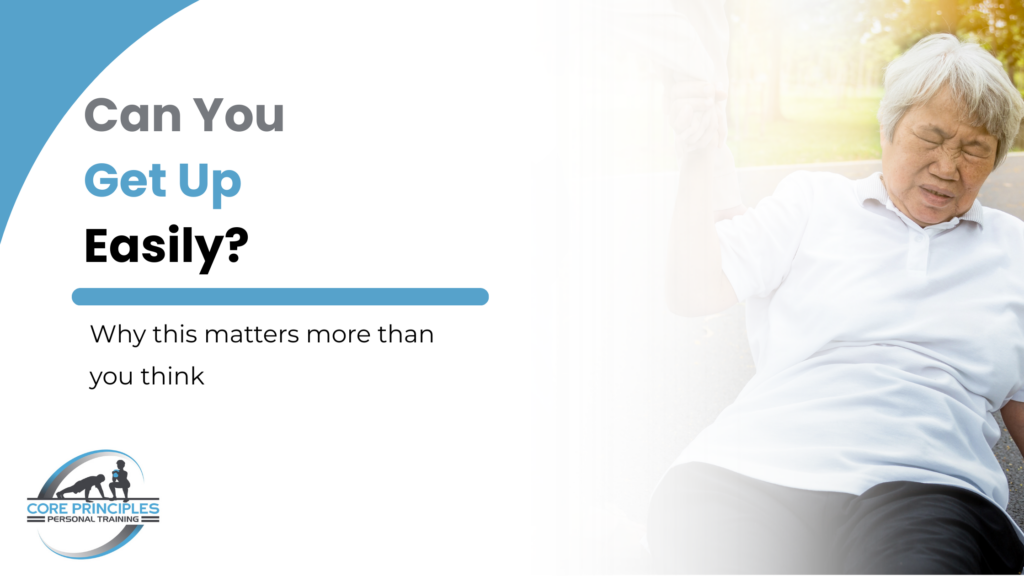
It’s not something most people think about—until they have to.
Maybe you dropped something and hesitated before bending down.
Or you sat on the floor with grandkids and quietly wondered, “How am I going to get back up?”
For many adults over 50, getting up from the floor starts to feel like something to avoid rather than something you can do without thinking.
And that matters more than it might seem.
Because the ability to get down—and more importantly, get back up—is closely tied to how independent, confident, and capable you feel in everyday life.
Why Does Getting Up From the Floor Matter So Much?
At first glance, it seems like a small thing.
But it connects to many parts of daily life:
- Playing with grandkids
- Reaching low cabinets
- Gardening or household tasks
- Recovering from a slip or loss of balance
In a place like Stamford, where life often includes walking local parks, staying active with family, or even just moving around your home comfortably, this ability shows up more often than you’d expect.
More importantly, it’s a form of self-reliance.
Knowing you can get yourself up—without needing help—creates a quiet kind of confidence that carries into everything else you do.
What Makes It Feel Harder Over Time?
If getting up from the floor feels difficult, it’s usually not about one single issue.
It’s a combination of:
- Leg strength (to push yourself up)
- Balance (to stay steady as you rise)
- Mobility (to move through the positions comfortably)
- Coordination (to sequence the movement)
If any one of these decreases, the whole movement feels harder.
The important thing to understand is this:
It’s not that your body can’t do it—it just hasn’t been practicing it.
Like anything else, the less you do it, the more unfamiliar (and intimidating) it becomes.
Can You Actually Improve This?
Yes—and often faster than people expect.
The key isn’t forcing yourself onto the floor and struggling through it.
It’s breaking the movement into smaller, manageable pieces and building them up over time.
Think of it like learning stairs again:
You wouldn’t jump to the top step right away—you’d start where it feels comfortable and build confidence from there.
What Does Practice Look Like?
You don’t need complicated routines.
Simple, guided movements can help rebuild the ability safely:
- Sit-to-stand from a chair
This is one of the closest everyday equivalents. It builds the leg strength needed to push up. - Supported transitions
Using something stable—like a bench, chair, or even a countertop—to assist as you move up and down. - Step-down and step-up movements
These help with control and coordination, similar to shifting positions from the floor. - Gentle floor practice (when ready)
Starting from a higher surface or using support to gradually work closer to the floor.
The goal isn’t perfection.
It’s familiarity and confidence.
How Often Do You Need to Work on This?
This is where many people feel relieved.
You don’t need to practice this every day.
In fact, 2–3 simple strength sessions per week—focused on these kinds of movements—can make a noticeable difference over time.
Between sessions, your body adapts.
That’s where the progress happens.
And because the movements are practical and controlled, they tend to feel approachable rather than overwhelming.
“What If I’m Afraid of Getting Stuck?”
This is one of the most common concerns.
The hesitation isn’t just physical—it’s mental:
“What if I can’t get back up?”
That’s a very real feeling.
The solution isn’t to ignore it—it’s to remove the risk while you build the skill.
That might mean:
- Practicing near a stable surface
- Having guidance or supervision at first
- Starting higher (like from a bench instead of the floor)
As your strength and confidence improve, that fear naturally starts to fade.
You replace uncertainty with experience.
It’s Not Too Late to Build This Skill
If this is something you’ve been avoiding, you’re not alone.
Many adults around Stamford feel the same way—but quietly.
The encouraging part is this:
The ability to get up from the floor is not “lost.”
It’s just underused.
And when you begin to practice—even in small, supported ways—your body responds.
Strength improves.
Movement feels more natural.
Confidence comes back.
Getting up from the floor might seem like a small thing.
But it represents something much bigger:
being able to rely on your body when you need it.
It’s one of those quiet abilities that supports independence, reduces hesitation, and helps you stay engaged in the life you enjoy—whether that’s time with family, activities around Stamford, or simply moving through your day with more ease.
If you’re not sure where to start, you don’t have to figure it out alone.
If you’re in Stamford, you’re always welcome to reach out to the team at Core Principles. We can help you build this ability step by step, in a way that feels safe, supported, and realistic—so you can feel more confident in your body again.