
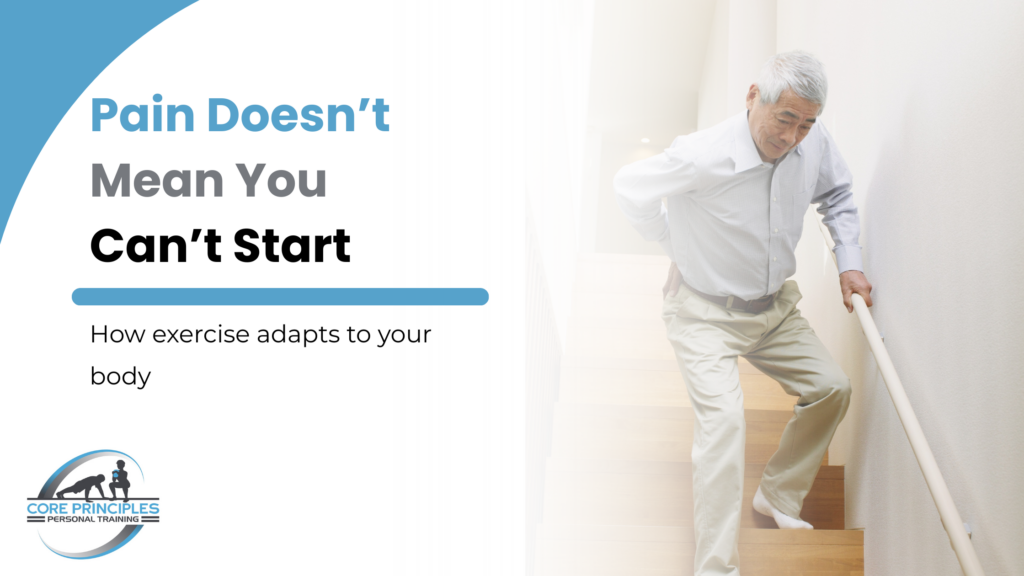
“I’d love to exercise… but my knee isn’t great.”
Or the shoulder.
Or the lower back that stiffens after sitting too long.
If you’re over 50, this thought is incredibly common. Many adults in Stamford who want to stay strong and independent hesitate not because they lack motivation — but because something feels unreliable.
You may wonder:
Will exercise make it worse?
Should I wait until it feels better?
This matters at this stage of life because movement isn’t about competition anymore. It’s about maintaining independence — climbing stairs comfortably, carrying groceries, walking along Cove Island without hesitation.
The good news? Starting exercise with knee, shoulder, or back discomfort is not unusual. In fact, it’s often exactly how people begin.
What Actually Happens When You Start Exercising With Joint Pain?
Most people expect one of two extremes:
- It will hurt more.
- It will magically disappear.
The truth is usually much calmer.
When exercise is adjusted properly, you typically experience:
- Controlled, manageable effort
- Gradual improvement in tolerance
- Less hesitation in daily movement
- Increased confidence over time
Pain doesn’t vanish overnight. But your relationship with it changes.
Think of a stiff door hinge. Avoiding it completely doesn’t improve it. Forcing it aggressively makes it worse. But gently moving it within a safe range often restores function over time.
Your joints respond similarly.
According to the CDC, strengthening muscles around joints helps improve stability and support as we age.
The key word is appropriate movement.
Does Exercise Make Joint Pain Worse?
When done incorrectly or too aggressively, it can.
But when structured appropriately, exercise often reduces discomfort over time.
Here’s why:
- Stronger muscles support joints
- Controlled movement improves coordination
- Gradual exposure reduces fear of movement
- Confidence decreases guarding and stiffness
Many adults are surprised that their knee feels more stable after a few weeks — not because it was ignored, but because surrounding muscles were strengthened carefully.
The National Institute on Aging highlights that strength training supports joint health and mobility in older adults:
The goal isn’t pushing through pain.
It’s working within comfortable ranges and expanding them slowly.
What a Safe Start Actually Looks Like
Starting exercise with joint discomfort doesn’t mean jumping into deep squats or overhead lifting.
It often looks like:
For Knees
- Sit-to-stand from a higher surface
- Smaller ranges of motion
- Slower, controlled repetitions
For Shoulders
- Angled pressing instead of overhead
- Lighter resistance
- Guided range adjustments
For Lower Back
- Core stability work
- Hip-focused movements
- Supported positioning
Sessions are usually calmer than people expect. More conversation. More adjustments. Less intensity.
After 50, progress comes from repeatable movement — not dramatic effort.
Why Waiting Often Makes It Feel Harder
Many adults delay exercise until the discomfort fully disappears.
But waiting can lead to:
- More stiffness
- More hesitation
- Less strength around the joint
- Increased uncertainty
Movement teaches the body that it’s safe.
Small, consistent exposure often reduces sensitivity more effectively than long periods of avoidance.
That doesn’t mean ignoring pain. It means adjusting intelligently.
Reassurance: You’re Not the Only One Starting This Way
Nearly everyone over 50 brings something with them:
- A knee that dislikes stairs
- A shoulder that feels tight reaching overhead
- A back that stiffens after sitting
These aren’t disqualifications.
They’re starting points.
Most people discover that their biggest limitation wasn’t the joint itself — it was uncertainty.
Once movements are adapted and feel manageable, confidence increases naturally.
And confidence changes how you move.
The Belief Shift That Makes the Difference
Instead of asking:
“Can I exercise with this?”
Try asking:
“How should exercise be adjusted for this?”
That small shift moves you from avoidance to strategy.
Exercise after 50 isn’t about ignoring discomfort.
It’s about building around it.
Progress Is Built Around Reality, Not Perfection
Starting exercise with knee, shoulder, or back discomfort is common — especially for adults who simply want to stay strong and independent in everyday Stamford life.
You don’t need perfect joints to begin.
You need appropriate movement.
Gradual progression.
And guidance that respects where you are today.
When exercise adapts to your body instead of forcing your body to adapt to exercise, progress becomes possible — and sustainable.
If you’d like to better understand what a safe starting point could look like for you, feel free to contact us for more information.
Sometimes clarity is the first step toward confidence.