
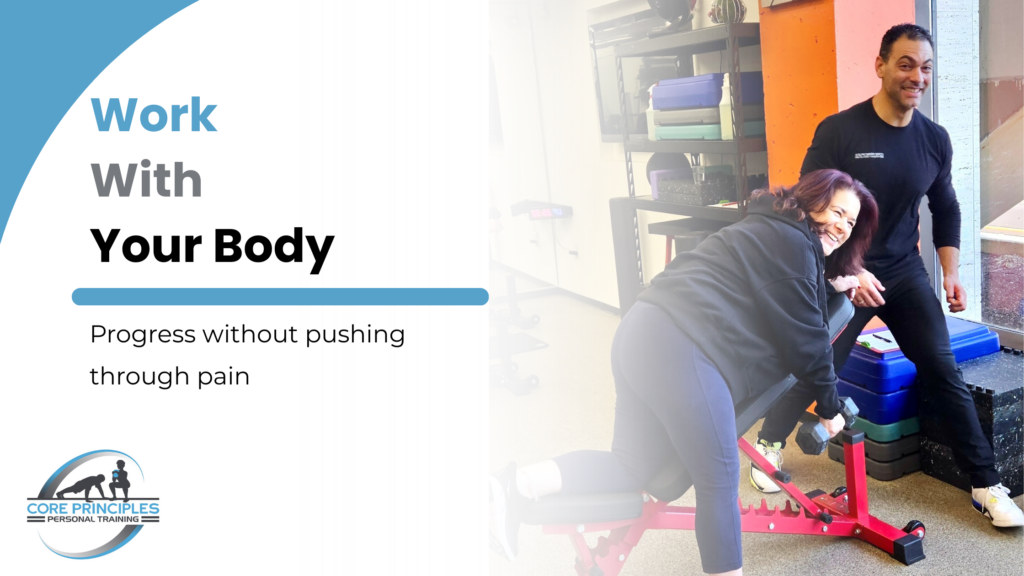
“I’d exercise… if my knee/shoulder/back didn’t act up.”
For many adults in Stamford — whether it’s after a long walk through Harbor Point or getting up from the couch after a movie — the hesitation isn’t about effort. It’s about uncertainty. People assume exercise requires a perfectly functioning body.
And if something feels unreliable, they wait.
The problem is that waiting rarely makes movement easier. Over time, daily tasks feel heavier not because of aging itself, but because the body stops practicing certain motions.
Understanding how modern exercise programs actually work changes that decision. Good programs don’t demand perfect joints. They adapt to the joints you already have.
Why This Matters More After 50
Earlier in life, exercise was optional performance.
After 50, movement becomes maintenance.
You’re not training for speed — you’re maintaining the ability to carry groceries, climb stairs, reach overhead, and react if you lose balance. The goal shifts from pushing limits to preserving capability.
According to the National Institute on Aging, strength and balance activities help maintain independence and reduce mobility decline.
But here’s the misunderstanding:
Many people believe discomfort means they must avoid movement.
In reality, the right movement is often what restores comfort.
Does Exercise Require Pain-Free Joints?
No — it requires appropriate movement.
Think of a stiff door hinge.
Avoiding it completely doesn’t fix it. Slamming it makes it worse. But gently moving it within a safe range gradually restores function.
Your joints respond the same way.
Good programs adjust:
- Range of motion
- Speed
- Support
- Load
So instead of forcing your body into exercises, exercises are reshaped around your body.
What “Working Around” Actually Looks Like
Most people imagine a fixed list of exercises.
Instead, movements have many versions.
Knee sensitivity
- Instead of deep squats → controlled sit-to-stand from a higher surface
Shoulder discomfort
- Instead of overhead lifting → angled pressing within comfort range
Balance concerns
- Instead of unstable positions → supported standing with hand contact
Back stiffness
- Instead of bending under weight → hip-hinge patterns with guidance
Same goal. Different path.
The objective is not intensity — it’s repeatability.
If a movement can be done comfortably today and tomorrow, progress becomes possible.
Why Avoiding Movement Often Makes Things Feel Worse
The body adapts to what it does regularly.
If you stop using a motion, your brain marks it as uncertain. And uncertainty shows up as tension, guarding, and stiffness.
Gradual exposure works differently.
Small, controlled movements teach the nervous system that the action is safe again. Over time, effort decreases — not because the movement changed, but because your body trusts it.
So improvement doesn’t come from ignoring limitations.
It comes from negotiating with them.
Reassurance: Having Limitations Is the Starting Point, Not a Disqualification
Nearly everyone beginning after 50 brings something:
- A knee that prefers certain angles
- A shoulder that dislikes overhead reach
- A hip that stiffens after sitting
- Balance that feels uncertain on uneven ground
These aren’t barriers to exercise.
They are the blueprint for the program.
Instead of asking, “Can I exercise?”
The better question becomes, “Which movements fit today?”
That shift turns fear into clarity. You no longer guess — you adjust.
And consistency grows when movements feel reliable.
Practical Guidelines for Starting Safely
You don’t need to tough it out. You need feedback.
Helpful rules:
- Movements should feel manageable while doing them
- Discomfort should not increase as repetitions continue
- You should feel more capable after sessions, not depleted
- Progress happens through repetition, not intensity
Improvement after 50 is less about pushing harder and more about repeating comfortable patterns until they become natural again.
Progress Comes From Adaptation, Not Perfection
Many adults delay exercise waiting for their body to cooperate.
But cooperation doesn’t come first — adaptation does.
When movements adjust to your current ability, your body gradually expands what it tolerates. Strength returns quietly. Confidence follows automatically.
You don’t fix limitations before starting.
You start, and the limitations begin to change.
If you’d like to better understand what a personalized starting point could look like, feel free to contact us for more information. Sometimes the clearest path forward begins with a simple conversation.